
Proposed Stadium and Economic Projections
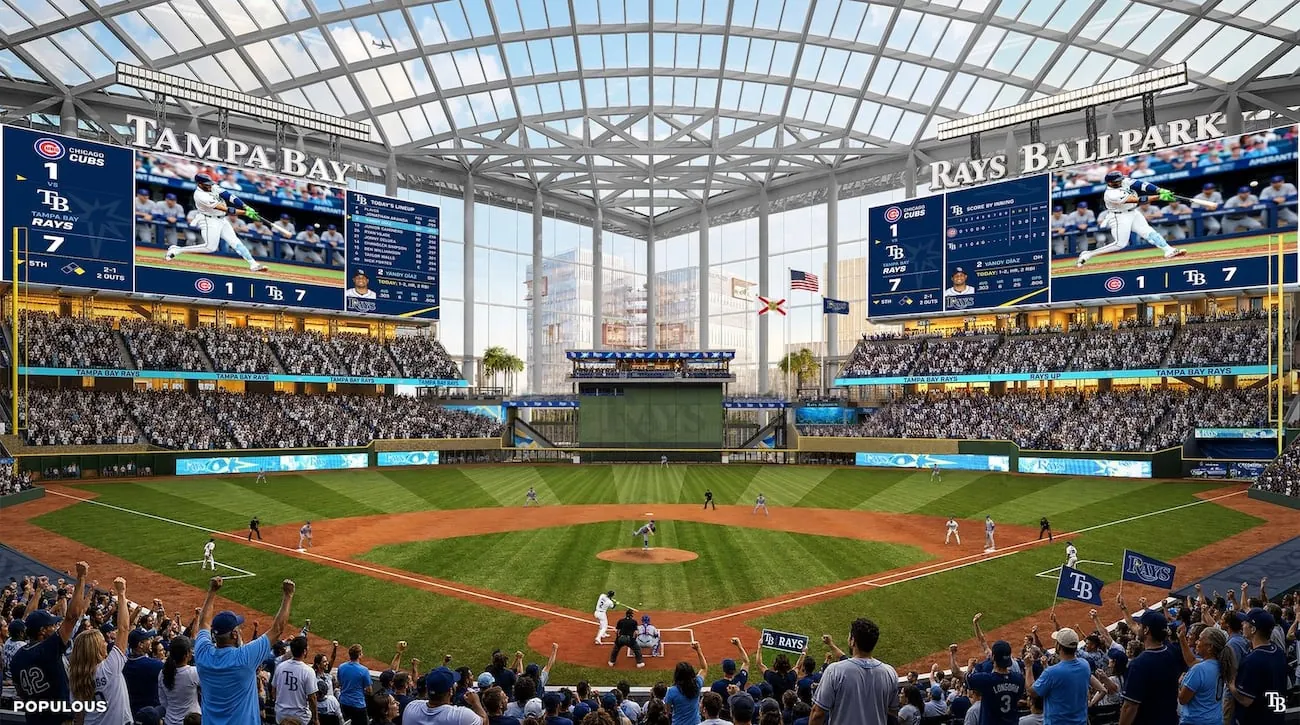
The Tampa Bay Rays are seeking nearly $1 billion in public funding from Hillsborough County, the City of Tampa, and the Community Redevelopment Agency (CRA) for a new $2.3 billion ballpark and mixed-use development. Team officials and local leaders suggest the project could generate up to $75.5 billion in economic impact over 30 years. The proposed development, spanning approximately 121 acres on the Hillsborough College Dale Mabry campus, would feature a new 31,000-seat enclosed ballpark. Surrounding the stadium, a privately financed mixed-use area is planned, including hotels, apartments, restaurants, commercial spaces, and a new Hillsborough College campus.
Under a Memorandum of Understanding (MOU) released in May 2026, the Tampa Bay Rays would contribute around $1.27 billion to the project. This contribution is described by the team as the largest private investment by a sports team in Florida history. The team would also be responsible for any cost overruns. The public investment outlined includes approximately $796 million from Hillsborough County, $80 million from the City of Tampa, and $100 million from the Drew Park Community Redevelopment Agency, totaling about $976 million in public commitment. The MOU is non-binding, and official plans have not yet been approved by Hillsborough County, the City of Tampa, or the CRA. The goal is to open the ballpark for the 2029 MLB season.
Economists Question Projected Benefits
Independent economists have expressed skepticism regarding the projected economic gains. Andrew Zimbalist, a sports economist with 36 years of experience studying professional sports venues, stated that there is no positive economic impulse from building a new stadium or bringing a team to an area. John Charles Bradbury, another sports economist, directly commented that stadiums are poor public investments.
A peer-reviewed study published in the Journal of Policy Analysis and Management, co-authored by economists John Charles Bradbury, Dennis Coates, and Brad Humphreys, concluded that research consistently shows professional sports stadiums generate little to no tangible economic impacts in host communities. The study indicated that typical public subsidies for new stadium construction generally exceed any meager economic benefits. Economists generally agree that sports venues represent poor public investments.
Some public officials, such as Hillsborough County Deputy Administrator Greg Horwedel, have expressed enthusiasm for the proposal, highlighting its potential to generate private investment, create jobs, expand the tax base, and drive long-term economic activity. Commission Chair Ken Hagan urged an open mind, describing the project as a once-in-a-lifetime transformational opportunity for the community. However, not all elected officials support using public funds for the stadium.
Critiques of Economic Impact Studies
The Rays project that the stadium would generate $55.5 billion in economic impact over 30 years, while a separate study commissioned by the Tampa Sports Authority estimated the figure at $75.5 billion over the same period. Zimbalist advised viewing these projections with skepticism, suggesting that firms producing such numbers are often paid to reach favorable conclusions. He noted that these studies typically rely on input-output analysis and unrealistic assumptions not endorsed by independent economists, allowing for a wide range of results.
The study by Bradbury, Coates, and Humphreys supported this view, finding that commissioned economic impact studies often deviate from established academic methods. These studies tend to present speculative projections using commercial computer models not common in academic research. They frequently make errors such as incorrectly identifying costs as benefits, overestimating benefits, underestimating costs, confusing gross and net spending, using excessive multipliers, and relying on unrealistic assumptions about future economic development. The researchers also suggested that these commissioned studies serve as public relations documents for a lay audience, with executive summaries highlighting positive forecasts to influence policymakers and community members already inclined to support stadium proposals.
A core argument from economists is the concept of the substitution effect, which posits that money spent at a ballpark is money not spent elsewhere in the local economy. Zimbalist explained that when people spend money at a ballpark, they are not spending it at other entertainment venues in the metropolitan area, which does not create a net change in economic circumstances. The Bradbury, Coates, and Humphreys study elaborated that most fan spending comes from existing area residents reallocating their spending from other local leisure options, meaning spending at sports events largely crowds out other local spending rather than representing new economic activity.
This concept, described as the economic fallacy of the seen and the unseen by 19th-century economist Frédéric Bastiat, highlights that stadium spending is visible and concentrated, while the displacement of spending from other local businesses like restaurants and movie theaters is dispersed and less apparent. Zimbalist provided an example: $200 spent at a ballpark is $200 not spent at a local bowling alley or restaurant. He added that when wealthy team owners and players benefit financially from a new stadium, that money tends to leave the local economy, as players and owners often do not reside in the town where the team plays.
Team Performance and New Stadium Renderings
The Tampa Bay Rays currently hold a strong home record this season, with 33 wins and 14 losses at Tropicana Field. The team split a four-game series with the New York Yankees, winning two games on Tuesday and Wednesday, which bolstered their lead over New York in the American League East division to five games. Jonathan Aranda contributed significantly with a three-RBI night in a 3-0 victory against the Yankees. However, the Rays lost the series finale to the Yankees on Thursday afternoon, despite a solo home run from Junior Caminero in the first inning.
The team released renderings of their proposed new ballpark, which is planned to span 130 acres near Raymond James Stadium. A notable feature of the new ballpark will be a roof offering a clear view of the sky. The stadium is planned to have approximately 30,000 fixed seats, with the flexibility to expand for special events such as concerts and conventions. There are also planned expansions for the team’s aquarium. The Rays maintain a four-game lead over the Yankees in the American League East.
Read Also
Source: tampabay28.com